Wolf Oven Repair
A Wolf Gas Oven That Lights, Then Drops Out
The cavity in an all-gas Wolf has its own burner under the oven floor. When it will not catch, or will not stay caught, the cause is ignition, flame sensing or gas pressure — and each symptom rules something out.
Signed off by
Gustavo Peralta
- Role
- Cooking-appliance technician — doors, hinges and seals
- In the trade
- 19 years
- Reached on
- (310) 706-2347
- On this page
- Wolf oven repair
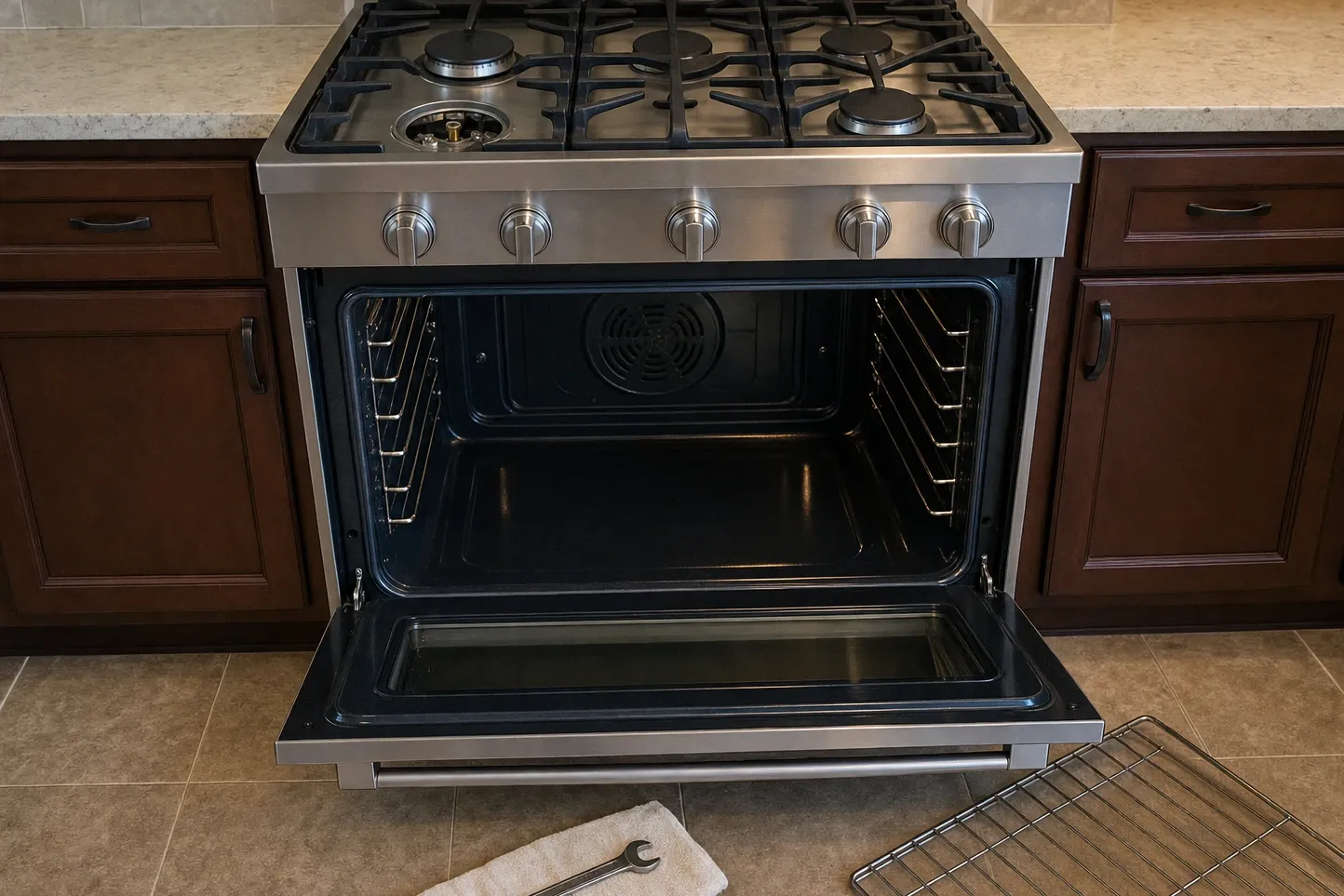
An all-gas Wolf is two appliances sharing a front panel. Above the counter, each sealed burner gets its own spark electrode and the clicking is the one part of it you can hear. Below, the cavity has a burner of its own, hidden under the oven floor, with its own ignition and its own way of proving that a flame is actually there. When the oven side stops working, the noise from the cooktop is the least useful evidence in the kitchen — and it is the evidence most people lead with on the phone.
What the noise actually proves
A burner that clicks has proved three things: the switch behind the knob is closing, the spark module is firing, and there is power. That narrows the fault, and it narrows it away from the control board, which is the part people arrive already worried about. Boards fail loudly — a dead display, a latch that will not release, nothing at all when a knob turns.
What clicking does not prove is anything about the cavity underneath. The oven does not light the way the cooktop does, so an oven that will not heat while every surface burner takes first time is not an ignition-module story. It is a story about the oven burner, the flame sensing around it, or the gas reaching it.
Where an oven burner loses its flame
Three patterns cover most of what we find, and they are told apart by timing rather than by symptom.
- It never lights. Nothing warms, the cavity stays at room temperature and the panel behaves normally. That points at the oven’s own ignition or at gas not arriving.
- It lights and then quits, minutes in. The range proves the flame continuously and shuts the gas when the proof disappears. A flashing oven indicator is that lock-out, and the knob off and on again clears it.
- It lights, holds, and the cavity still bakes under. That is not an ignition fault at all. It belongs with sensor drift, a tired seal or a door that has stopped sitting square, which is a different guide and a different measurement.
The second of those is the one worth catching early, because a lock-out that repeats is telling you something is marginal — and marginal is what gets worse in August.
Pressure, and why a manometer comes out
Wolf publishes the figures its appliances expect, and they are not folklore. On natural gas the regulator on the product is fed between seven and fourteen inches of water column and delivers five inches after it; on LP the supply is eleven to fourteen inches and ten comes out. Those are the numbers a technician reads against, and reading them takes an instrument rather than a judgement. An orifice set for propane on a natural-gas supply, or a shut-off behind the range left half turned after a remodel, both show up here and neither is visible from the kitchen.
This is also the point at which the honest advice is to stop. Opening a gas connection, putting a flame to a burner that has been failing to light, or working on the valve are all technician work. If gas can be smelled at all, the appliance goes off, a window goes open, and nobody uses it until it has been looked at.
What Los Angeles does to this
Geography changes what we bring rather than what we look for. Out in the west valley, dust off the hills and cooking grease bake onto the igniter and its lead through a run of hundred-degree days, and the oven’s cooling side is working against air that is already hot. Within a mile or two of the water the failure is different: salt reaches the terminals, the fixings and the plated hardware, and the part that fails is a connection rather than a component. A coastal range wants its terminals sealed rather than merely cleaned. A valley range wants the heat path kept genuinely clear.
When it is worth calling somebody out
Call if the oven will not light at all, if a lock-out has happened more than once, if the appliance has recently been moved, or if anything smells of gas. Those are not maintenance problems. Oven repair here is a flat $89 in Los Angeles, which covers the trip and a full diagnosis and comes off the repair if you approve one. What that buys is the half hour with a manometer and a meter that turns four possible causes into one — and it is a great deal cheaper than a control board fitted to an oven that needed an igniter and an open valve.
Follow-ups we get asked
The cooktop lights but the oven will not. What does that tell you?
That gas is reaching the appliance and the fault is downstream of the manifold. Above and below are almost separate machines sharing one panel: the cooktop takes a spark at each burner, the cavity has its own burner, its own ignition and its own flame sensing. One working proves very little about the other.
The oven runs for a while, then the indicator starts flashing. Is that a fault?
It is the range telling you it lost the flame and went into lock-out, which is a safety response rather than a breakage. Turning the oven knob off and back on again clears it. What matters is how often it happens: once after a power blip is nothing, twice in a week is a diagnosis.
Is there anything safe for me to check first?
Two things, and then stop. Confirm the range is plugged in and the breaker has not tripped, because an all-gas Wolf still runs its ignition and its oven controls on electricity. Then note what the panel is doing and when. Gas, the burner and the valve are technician work, not owner work.
Why would an oven that worked for years suddenly go off?
Usually something moved rather than something aged. A range pulled out for a floor or a backsplash goes back with a shut-off valve not fully open, a strained connector, or a scorched igniter lead resting somewhere new. A remodel is the single most common thing sitting behind a sudden no-heat call here.